
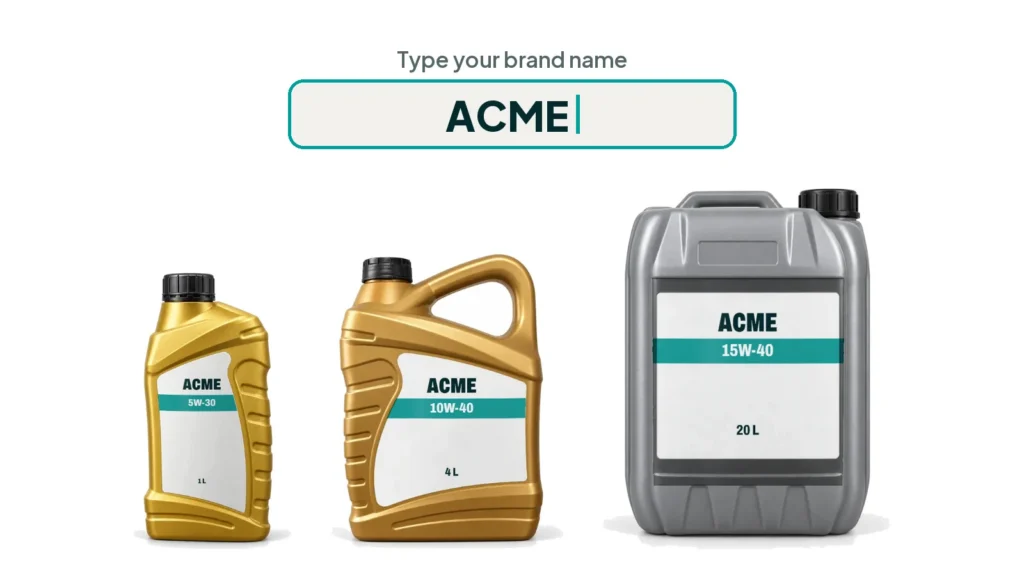
You can start your own motor oil brand without building a blending plant, a filling line or a laboratory. In private label, you own the brand, the customers and the margin, and an experienced manufacturer produces, fills and labels the oil for you. This guide walks you through the whole journey in 9 steps, from studying your market to selling your first cans.
Key takeaways
- You don’t need a factory: a private label manufacturer blends, fills and labels the oil under your name.
- Start small and focused: 3 to 5 grades that your market already buys, not a full range.
- Check your brand name and register the trademark in your own name before you print anything.
- Test samples with real mechanics before your first order.
- With ready designs, production takes about 30 working days, plus shipping to your country.
Why start your own motor oil brand?
Engine oil is one of the steadiest products a business can sell. Oil wears out: it gets dirty, it is drained at every service, and it can’t be used again. A typical car comes back for fresh oil about every 10,000 km, and trucks, buses, taxis and tractors that work every day need it sooner. Every one of those engines also needs gear oil, brake fluid, coolant and grease.
Selling well-known brands builds a good business. Adding a brand of your own builds something you own:
- Your name on the shelf. Every refill and every repeat order builds recognition for you.
- Your margin and your price. You decide where your brand sits in the market.
- Your customer relationships. Workshops and shops ask for your name, and they keep coming back to you.
What about electric cars? In most export markets, most cars on the road still run on petrol or diesel, and many are older cars kept running for years. Trucks, tractors, generators and factory machines all need lubricants too, and even electric cars still need gear oil, grease, brake fluid and coolant. The demand isn’t going away, so start where the engines are today.
Step 1Study your market before you choose anything
The best brands start with what customers already buy. Spend a few days on the ground:
- Walk the shelves. Visit ten shops and workshops and write down which grades take up the most space.
- Look at the vehicles on your roads. Older engines and newer engines often need different grades.
- Think about your climate. Hot and cold markets can need different oils.
- Ask the people who change the oil. A mechanic will tell you exactly what they use every day.
Then decide who your first buyers will be: workshops, parts shops, fleets or petrol stations. Each one buys different products and pack sizes.
Step 2Choose your first 3 to 5 grades and pack sizes
It is tempting to launch a full range. Don’t. A full range ties up your money in stock that sits on the shelf. With three to five grades, you know them well, you explain them well, and they move fast. When your buyers ask for more, you add more with your next order.
Most new brands start with the biggest group, passenger car engine oils, and add the products their buyers ask for next: heavy-duty diesel oils for fleets, gear oils, antifreeze, brake fluid or grease. At Özerşah Group you can choose from 191 grades in 11 product groups, made to API, ACEA and ISO VG specifications.
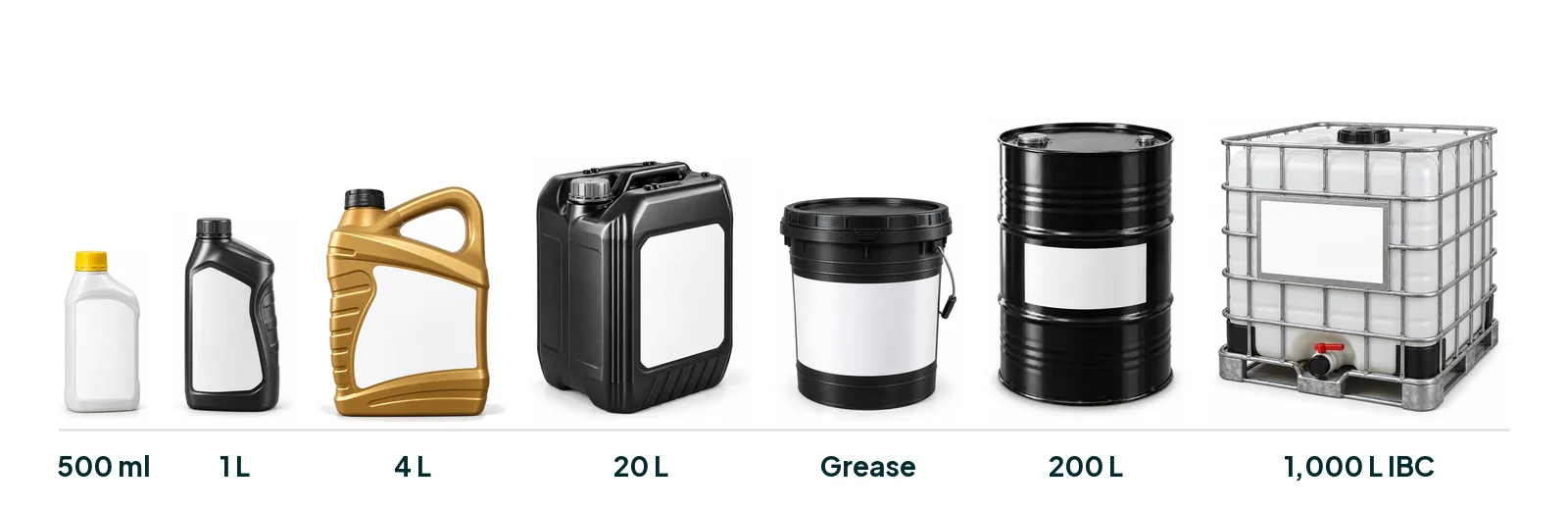
Then match the pack to the buyer:
| Pack | Who buys it |
|---|---|
| 500 ml – 1 L | Top-ups, motorcycles, small engines, brake fluid |
| 3 – 5 L | Car owners and workshops: the sizes drivers know best |
| 16 – 25 L | Trucks, tractors and busy workshops |
| 60 – 200 L drums, 1,000 L IBC | Fleets, factories and high-volume workshops |
Choose a brand name, and protect it
Your name is the one thing customers will remember. A good oil brand name is:
- Short, so it is easy to remember and fits well on a can.
- Easy to say in your language. If a mechanic can’t say it, a mechanic won’t ask for it.
- Safe in every language of your market. Check that it doesn’t mean something bad.
- Free to register. Don’t fall in love with a name someone else already owns.
Before you print anything, search your country’s trademark office, then register the name in the country where you will sell it and in the right product class. Rules, costs and timing differ by country, so a local trademark agent or lawyer is worth the small fee. The brand belongs to you, so the registration should be in your name.
Step 4Choose your packaging route
There are three ways to put your brand into the market. Each suits a different stage of business:
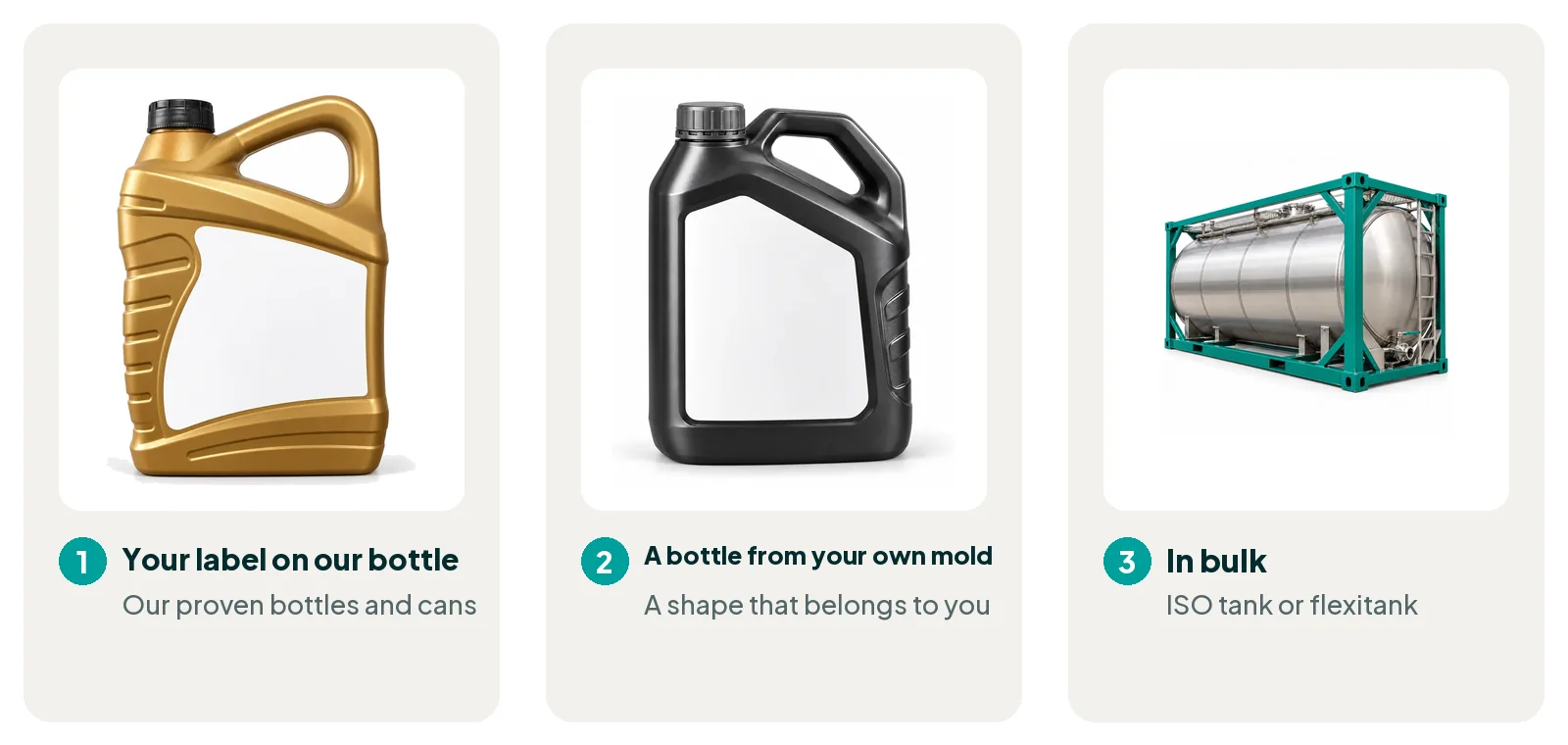
1. Your label on our bottle
The fastest and easiest start. Your label goes on proven standard bottles and cans, so there is no packaging to develop and you can launch a wide range quickly. Best for a first launch or testing a new market.
2. A bottle from your own mold
Here the bottle itself becomes part of your brand. It is produced from your own mold, so the shape on the shelf belongs to you alone, and it is much harder for others to copy. Best for established distributors who want to stand out.
3. In bulk
If you have your own filling line, the oil is supplied in an ISO tank or a flexitank, and you fill and label it at your own plant. Best for companies with their own packaging capacity.
You can compare all three routes, see your brand on the packs, and build a complete request on our private label lubricants page.
Step 5Design a label that sells, and is legal
If you already have designs, the manufacturer uses them. If you don’t, our design team can create your logo, labels and boxes with you, at a standard or premium level. You share your name, your colours and your market; you see and approve every design before production starts. Even when our team helps you, the design belongs to you.
A label isn’t only a design. Every market has its own rules, so treat this as a checklist and confirm it with your local authority or customs broker before you print:
- The product name and the grade, so the buyer knows what is inside.
- The volume and the batch number.
- Very often, your own language and your details as the importer.
Test samples with real customers
You don’t have to decide blind. Ask for samples of the products and grades you are considering. Check the oil, the pack and the label, and show them to the workshops and shops you want to sell to. Their reaction tells you which grades they want and which pack sizes sell.
Ask for the documents too: the certificate of analysis (COA), which shows the test results, and the safety data sheet (MSDS). Your first order is then planned with real feedback, not guesses.
Step 7Get a written quotation, then order
Send your request with your products, packs, quantities and branding. At Özerşah Group you receive a written quotation within 2 working days, so you see exactly what you are buying and the price before you decide.
When you approve it, payment is by bank transfer (TT). You don’t pay everything up front: around 30 to 50% is enough to start production, and your salesperson tells you when the rest is due. Always confirm the bank details with your salesperson before you send money.
| Stage | Typical time |
|---|---|
| Written quotation | Within 2 working days |
| Production with your designs ready | About 30 working days |
| Production with our design support | 21 to 45 working days |
| Shipping | Depends on your port and route |
Ship it and bring it through customs
You choose how the goods are delivered:
- EXW: you collect from the plant.
- FOB: the goods are delivered onto the ship at the Turkish port.
- CIF: the goods are shipped to your port, with insurance included.
The export documents are prepared for you: commercial invoice, packing list, certificate of origin, MSDS and COA. On your side, have these ready before the ship arrives:
- A company that can import and sell legally in your country.
- An import licence, if your country requires one.
- A customs broker. Talk to one before you order, and ask which approvals your market requires.
- Dry, safe storage, away from rain, strong sun and high heat. Sell your oldest stock first.
Launch: your first buyers, your shelf space, your price
Find your first buyers
Start with the four places that buy oil every week: workshops, parts shops, fleets and petrol stations. Make a list of twenty names near you and visit them yourself. Your first buyers are often very close.
Earn the shelf
A new brand starts with people. Give out samples, visit the mechanics, and offer shops a fair margin. A mechanic who trusts your oil tells the next driver. Go back again and again: trust grows with every visit.
Set your price
Look at the shelf first: which brands are there and what they sell for. Take your real landed cost per can, add what you need to keep, and leave a fair part for the shop. If your price is close to the brands next to you, you’re in the game. The cheapest isn’t always the best; quality and service keep customers coming back.
Market it without a big budget
Posters and stickers in the workshops that sell your oil, a WhatsApp list of your mechanics and shops, social media in your own language, and small gifts like caps or calendars all work locally and cost little. Most of all, keep your promise: one happy mechanic is your best advert.
How to choose a private label oil manufacturer
Your customers will judge your brand by what is inside the bottle. Before you sign with any manufacturer, ask these questions:
- Do you blend and fill in your own plant? Can I visit it?
- Which approvals and certificates do you hold? Look for API licensing, ACEA and ISO management standards.
- Do you test every batch in your own laboratory, and will I receive a COA?
- Can every can be traced by batch number if a customer ever has a complaint?
- Who owns the brand, logo and label design? The answer should be: you.
- Will you fill my brand for anyone else? The answer should be no, and exclusivity should be possible.
- Can I test samples before I order?
- Will I get a written quotation, with clear lead times and payment terms?
Here is how Özerşah Group answers them. We have produced lubricants since 1998 in our own plant in Kocaeli, Türkiye, with our own laboratory, and you are welcome to visit. Our engine oils are API licensed and ACEA registered, production is ISO 9001, ISO 14001 and ISO 45001 certified, and capacity is 60,000 m³ a year. Every can carries a batch number; if a customer has a problem, our technical team checks the batch in our lab and gives you a written evaluation. What we make under your brand is made only for you, and exclusivity for your region can be agreed.
5 mistakes to avoid when you launch
- Too many grades. Start with three to five, not a full range.
- The wrong grades. Study your market first; don’t guess.
- No buyers lined up. Talk to your first shops before the goods arrive.
- All your money in stock. Keep cash for your running costs.
- No budget for shipping and customs. Count them before you order, not after.
And be honest with yourself: this isn’t a quick-money business. A brand and a customer list take time, and they are built face to face. If you are patient, you like people and you plan your numbers, it can be a very good one.
Prefer to start with brands that are already established? You can also become a lubricant distributor of our own brands first, and add your own brand later.
Frequently asked questions
Do I need my own factory to start a motor oil brand?
No. In private label, a manufacturer blends, fills, labels and packs the oil under your brand. You focus on your market, your customers and your sales.
Who owns the brand and the label design?
You do. The brand name, the logo and the label design belong to you, even when our design team helps you create them. Register the trademark in your own name.
Will you sell the same product under my brand to someone else?
No. What we make under your brand is made only for you and filled for your orders. If you want your region protected, exclusivity can be agreed with you.
Can I test the oil before I order?
Yes. Ask for samples of the grades you are interested in, together with the certificate of analysis and the safety data sheet, and test them with your own customers.
How many products should I start with?
Three to five grades that your market already buys. A small range sells faster and keeps your money working; add more grades with your next order.
How does payment work?
By bank transfer (TT). After you approve the written quotation, a first payment of around 30 to 50% starts production, and your salesperson tells you when the rest is due.
Which documents come with the shipment?
The commercial invoice, packing list, certificate of origin, safety data sheet (MSDS) and certificate of analysis (COA). Check with your customs broker which approvals your market requires.
See your brand on our bottles
Type your brand name into our online tool, choose your products and packaging, and send one request. Our team replies with a written quotation within 2 working days. No obligation.
Start with your brand name → WhatsApp our team