
Marine Lubricants in a War Economy:
Keeping Fleets Moving When Routes Are Disrupted
The World's Shipping Lanes Have Been Redrawn
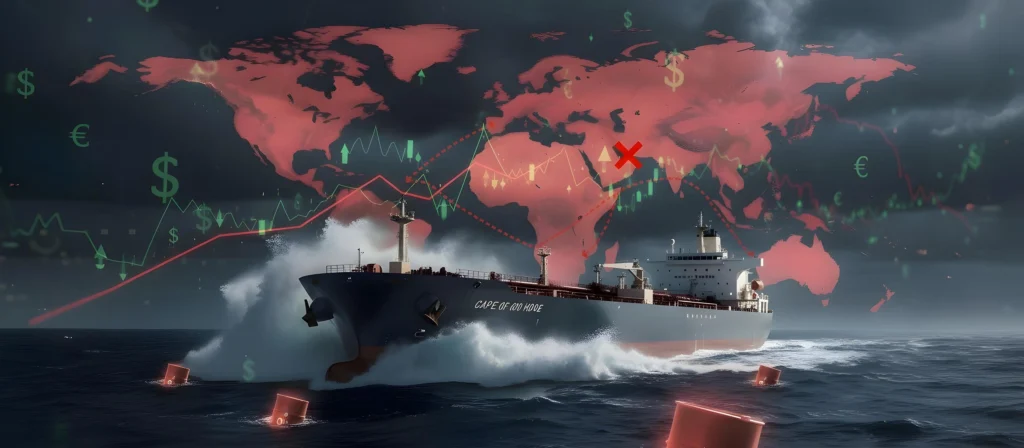
On March 2, 2026, for the first time in the history of global oil markets, zero ships crossed the Strait of Hormuz. For maritime operators, the question is no longer whether your routes will change — it is whether your vessels are prepared for what comes next.
Over 400 vessels are currently anchored in the Gulf of Oman, engines idling, waiting. They have been there since February 28, 2026 — the day that coordinated US-Israel strikes targeting Iranian military infrastructure instantly transformed the world's most critical oil chokepoint into a no-go zone. The IRGC broadcast a clear message over VHF radio to every vessel in the area: no ship was permitted to pass.
The Strait of Hormuz normally carries approximately 20 million barrels of oil per day — around 20% of all global seaborne oil trade, and 22% of global LNG exports. Commercial traffic collapsed to zero by March 8. Insurance was cancelled. Major container shipping companies including Maersk, CMA CGM, Hapag-Lloyd, MSC, and COSCO suspended all transits.
At the same time, Houthi-controlled Yemen resumed attacks on commercial shipping in the Red Sea on February 28, reversing the limited progress made after the 2025 Gaza ceasefire. In a single day, both of the world's most vital maritime shortcuts — Hormuz and the Suez Canal — became commercially unnavigable simultaneously. It had never happened before.
Fleets are now rerouting around Africa's Cape of Good Hope, adding 3,500 to 4,000 nautical miles and up to 14 additional days at sea to every voyage. This article explains what that means specifically for marine lubrication: what happens to engines on longer voyages, what the supply disruption means for lubricant availability, and what fleet operators need to do right now to protect their assets.
The Crisis in Numbers: What Fleet Operators Are Facing
Before examining the lubrication implications, it is essential to understand the scale of the disruption. These are not projections — they are the verified operational reality as of mid-March 2026.
The Hormuz Closure
- The Strait of Hormuz normally carries approximately 20 million barrels per day — roughly 20% of all global seaborne oil trade and 22% of global LNG exports.
- In 2024, 84% of crude oil flowing through Hormuz was destined for Asian markets. China received a third of its oil via the strait. Japan sourced 95% of its crude from the Middle East — nearly all of it through Hormuz.
- Protection and indemnity insurance was cancelled for Gulf transits from March 5, making the strait commercially unnavigable for virtually all operators regardless of their position on the conflict.
- By March 14, AIS-confirmed crossings had fallen to zero, with approximately 400 vessels operating in the Gulf of Oman in a wait-and-see posture.
- At least 21 commercial vessels were struck or affected between February 28 and mid-March, including the Thai-flagged Mayuree Naree, which suffered a severe engine-room fire after being hit by Iranian projectiles 11 nautical miles north of Oman.
The Red Sea Double Blockade
- Houthi forces resumed attacks on commercial vessels on February 28, 2026, collapsing both chokepoints simultaneously.
- Suez Canal transits, which were recovering toward 120 vessel passages per month after the partial easing in late 2025, dropped sharply again within days.
- The dual closure creates what supply chain planners call the nightmare scenario: there is no fast routing option for Gulf-bound cargo anywhere in the northern hemisphere.
The Cape of Good Hope Reality
- The Cape route adds approximately 3,500 to 4,000 nautical miles per voyage, with transit time increasing by 10 to 14 days depending on vessel class and speed.
- Cape crossings surged 89% in a single day in early March as the rerouting shift accelerated globally.
- By March 10, 80 vessels were recorded crossing the Cape in a single day — including 31 bulk carriers, 16 container vessels, and six oil and chemicals tankers.
- Sea conditions around the southern tip of Africa are significantly more severe than the enclosed waters of the Persian Gulf or Red Sea, with frequent heavy swells, high winds, and violent weather systems that place additional mechanical stress on vessels and all onboard equipment.
A vessel that previously completed a typical Gulf-to-Asia voyage in 22 days is now running a 34 to 36-day voyage — adding more than 300 additional engine operating hours per round trip. The lubrication strategy that was adequate for that vessel six weeks ago is no longer adequate today.
The Lubrication Challenge of Longer Voyages
This is where the geopolitical crisis becomes a direct engineering problem. Extended operating hours do not simply mean more time at sea — they mean your lubricants are working harder, degrading faster, and being asked to protect components that were not maintained with this voyage length in mind.
1. Additive Package Depletion
Every marine lubricant contains a carefully balanced package of additives: detergents, dispersants, anti-wear agents, oxidation inhibitors, and alkalinity reserves measured as Base Number (BN). These additives are consumed during engine operation — not at a constant rate, but in response to load, temperature, and fuel quality. An extra 300 operating hours per voyage accelerates this depletion significantly.
Cylinder oils: For large two-stroke engines burning Heavy Fuel Oil (HFO) or Very Low Sulphur Fuel Oil (VLSFO), the BN reserve of the cylinder oil is the primary defence against corrosive wear. Sulphur in the fuel combines with water during combustion to form sulphuric acid. The cylinder oil must neutralise this acid before it attacks the liner. A vessel running significantly more hours between port calls than anticipated can exhaust this reserve before the next scheduled oil change — leaving cylinder liners exposed to accelerated corrosive wear with no chemical protection.
2. Cylinder Liner Wear Rates
Industry standards define an acceptable liner wear rate of 0.05 to 0.1 mm per 1,000 running hours for most commercial marine engines. At these rates, well-maintained engines can run for years without major overhaul.
However, this standard assumes appropriate lubricant quality, correct oil feed rates, and regular monitoring. On an extended Cape voyage with potentially depleted cylinder oil, wear rates can climb well outside this range — compressing timelines for liner replacement and increasing the risk of costly in-service failures such as blow-by, piston ring damage, or in the most severe cases, engine seizure.
A lubricant that was adequate for a 25-day voyage on a specific trade route may not be adequate for a 39-day voyage in heavier sea conditions with the same maintenance interval. This is not a theoretical risk — it is an operational certainty for vessels that do not adjust their lubrication strategy to match their revised voyage profile.
3. Cape Conditions and Mechanical Stress
The sea conditions around the Cape of Good Hope are categorically different from the enclosed, relatively calm waters of the Persian Gulf or Red Sea. The southern tip of Africa sits in one of the world's most consistently rough maritime environments — the meeting point of the South Atlantic and Indian Oceans, subject to frequent storms, swells of four to six metres, and strong beam winds.
- Rolling and pitching motion affects oil circulation within the engine sump and crankcase. In extreme cases, violent motion can disrupt the oil film on bearings, creating momentary conditions of boundary lubrication or even metal-to-metal contact.
- Hydraulic systems face increased demand as steering responds continuously to sea conditions. Hydraulic fluid quality and condition becomes a critical safety factor, not just a maintenance consideration.
- Stern tube and propeller shaft lubrication is placed under additional stress as the propeller works harder against high sea states, increasing the load on the stern tube bearing and its lubricant.
- Deck machinery — winches, cranes, hatch cover systems — require properly maintained greases and hydraulic fluids to operate reliably under dynamic load in heavy weather.
4. Temperature Range Across the Voyage
A vessel rerouting from the warm Persian Gulf (where sea surface temperatures average 28 to 32°C) to the cold South Atlantic around the Cape (where temperatures can fall to 10 to 15°C) experiences significant thermal variation across a single voyage. Lubricants formulated with a narrow viscosity window can thicken at low temperatures, increasing resistance and wear at cold starts, while also being at risk of oxidation and viscosity breakdown under sustained high load in warmer sections of the route.
The viscosity index (VI) of a lubricant — its ability to maintain consistent viscosity across a temperature range — becomes significantly more important on Cape route voyages than it was on the enclosed Gulf and Red Sea lanes these vessels were previously using.
5. Auxiliary Systems and Extended Drain Intervals
It is not only the main propulsion engine that is affected. Every system onboard accumulates more operating hours on an extended voyage:
- Auxiliary diesel generators run for longer without the port call downtime that previously allowed for regular servicing and oil changes.
- Compressors, purifiers, and pumps all accumulate wear beyond their designed maintenance intervals.
- Gear and transmission systems in stern tubes, reduction gearboxes, and deck machinery are subjected to extended stress cycles.
For vessels that cannot reach a port for scheduled oil changes, the quality and formulation of the lubricant itself becomes the primary safeguard. This is precisely the scenario where high-quality synthetic and semi-synthetic formulations — with their superior oxidation resistance, extended additive package life, and better high-temperature stability — justify their cost multiple times over in avoided engine damage.
The Supply Chain Paradox: Harder to Source When You Need It Most
The irony of the current situation is stark. At precisely the moment when marine lubricant quality and availability matter most, the supply chain for those lubricants has been disrupted by the same crisis that is driving demand.
Base Oil Feedstocks Under Pressure
Marine lubricants are manufactured from base oils refined from crude oil, combined with additive packages. Many Group I and Group II base oils are produced in refineries that source their crude from the Gulf region. With Hormuz closed, feedstock availability has tightened and base oil prices have risen sharply alongside crude. Lubricant manufacturers globally are facing increased input costs, and in some cases, reduced production throughput as supply chains adjust to the new reality.
Fujairah: The Bunkering Hub That Has Been Hit
Fujairah, located in the United Arab Emirates just outside the Strait of Hormuz, is one of the world's most important bunkering hubs — a critical supply point for both bunker fuel and marine lubricants for vessels transiting the Gulf. In mid-March, a drone-related fire temporarily halted oil loading operations at Fujairah, directly disrupting supply to vessels that would normally top up there. For fleet operators that relied on Fujairah as a standard replenishment point, this disruption means rethinking the entire lubricant supply chain for Gulf-bound and Asia-bound voyages.
The Port-of-Call Problem on the Cape Route
Rerouting around the Cape dramatically changes which ports are accessible for lubricant resupply. The major supply points that now matter most are:
- Salalah, Oman — currently one of the most accessible Middle East ports for Cape-routed vessels approaching the region from the south.
- Cape Town, South Africa — a natural waypoint for replenishment on the Cape route, but with limited specialist marine lubricant inventory compared to major bunkering hubs.
- Las Palmas, Canary Islands — an important waypoint on the Europe-bound leg for vessels that have rounded the Cape from Asia.
- Singapore and Port Klang — continue to function as the primary lubricant supply hubs for Asia-Pacific, providing a stable supply point for vessels completing the Cape route.
Vessels that have not pre-arranged lubricant supply at these waypoints face the real risk of arriving short of critical stock, with limited options for emergency procurement in ports that were not previously part of their maintenance planning.
Turkey's Strategic Position
As the Hormuz crisis has unfolded, Turkey has emerged as one of the most strategically positioned manufacturing and logistics hubs in the lubricants supply chain. Located outside the conflict zone, with established export infrastructure, and maintaining active manufacturing operations at scale, Turkish lubricant producers are in a unique position to supply global markets at a moment when Gulf-based supply chains have been severely constrained.
Özerşah Group, based in Kocaeli on the northeastern coast of the Marmara Sea, is operating at full production capacity with active export logistics to over 50 countries. Our multi-brand portfolio — Monex, Hexon, WOIL, and Ring — provides the flexibility to match specific performance requirements across vessel types and operating conditions, all manufactured to ISO, SAE, and ASTM international standards.
In a disrupted logistics environment, your lubricant supplier's geographic location, export capability, documentation speed, and supply chain flexibility matter as much as the product specification. A supplier whose manufacturing base sits outside the conflict zone is not a minor logistical advantage — it is a strategic operational asset.
What Fleet Operators Should Do Right Now
The following actions are recommended for fleet operators whose vessels are affected by the current route disruption. They are listed in approximate order of urgency.
- Audit current oil drain intervals against revised voyage lengths. If your vessels are now running 30 to 40% more operating hours between port calls than they were six weeks ago, your maintenance schedule is out of date. Review specifically: cylinder oil BN depletion rates, system oil oxidation status, and hydraulic fluid condition on all vessels currently on Cape routes.
- Reassess lubricant specifications for Cape route conditions. Verify that your current marine engine oils, hydraulic fluids, and greases are rated for the temperature range, sea conditions, and extended operating hours you are now encountering. Pay particular attention to viscosity index ratings and oxidation stability test results.
- Do not compromise on cylinder oil BN for HFO and VLSFO vessels. With extended voyages and limited port access, the alkalinity reserve in your cylinder oil is your primary protection against corrosive liner wear. Ensure you are using a cylinder oil with a BN specification appropriate to the fuel sulphur content you are burning, and that you have sufficient stock for the full voyage duration including contingency.
- Switch to synthetic or semi-synthetic formulations where operating conditions allow. Synthetic lubricants provide significantly better oxidation resistance, extended additive package life, and more stable viscosity across temperature ranges than conventional mineral oils. For vessels now running longer voyages with less frequent port access, the additional cost of synthetic formulations is easily justified by reduced engine wear and extended drain intervals.
- Pre-position lubricant stock at Cape route waypoints now. Contact your lubricant supplier — not when your vessel is 48 hours from Salalah or Cape Town, but now. This requires your supplier to have active export logistics and the ability to deliver to non-standard ports on short notice.
- Increase oil analysis frequency for vessels on Cape routes. If your standard programme calls for monthly oil samples, move to bi-weekly during the disruption period. Early detection of elevated metal content, rising acid number, or depleted BN gives you the opportunity to adjust feed rates or schedule emergency oil changes before minor wear becomes major damage.
- Review hydraulic fluid and auxiliary system lubricant stocks separately from main engine oils. The tendency in emergency situations is to focus on main propulsion. But hydraulic failures, stern tube failures, and auxiliary engine problems cause vessel downtime that is just as costly. Ensure all systems are covered in your extended voyage planning.
- Confirm your lubricant supplier's current export capability and lead times. If your current supplier's production or logistics are affected by the Gulf disruption, identify alternatives before you need them. Turkey-based suppliers with confirmed export capacity to key wayport locations are a strong option in the current environment.
How Özerşah Group Supports Marine Operators
Özerşah Group has been engineering lubricant solutions for commercial and industrial applications for over 28 years. Our marine lubricants division supplies vessels, fleet operators, marine distributors, and offshore installations across more than 50 countries, operating under ISO, SAE, and ASTM international certifications.
Marine Products
Our marine lubricant range is formulated specifically for the demands of commercial vessel operation. The portfolio covers:
- Cylinder oils — formulated for two-stroke slow-speed engines operating on HFO and VLSFO, with BN grades matched to fuel sulphur content and extended drain interval capability.
- System and crankcase oils — for main engine crankcase, trunk piston engine, and crosshead system lubrication with high oxidation stability for extended operating periods.
- Marine gear and transmission oils — engineered for reduction gearboxes, azimuth thrusters, and controllable pitch propeller systems, with extreme pressure and water separation performance.
- Marine hydraulic fluids — anti-wear formulations with high viscosity index and thermal stability for steering gear, hatch covers, deck cranes, and stabiliser systems.
- Stern tube lubricants — biodegradable and conventional options for water-lubricated and oil-lubricated stern tube arrangements.
- Marine greases — multi-purpose, extreme pressure, and water-resistant greases for windlasses, mooring equipment, anchor chains, and all deck and below-deck grease points.
- Auxiliary and generator engine oils — for medium-speed four-stroke engines powering onboard electrical generation and propulsion auxiliaries.
Supply Chain Stability from Kocaeli, Turkey
Our manufacturing facility in Kocaeli is operating at full production capacity. Turkey's position outside the direct conflict zone — and its established role as a neutral trading hub in the current environment — means we can offer consistent supply, confirmed export documentation, and reliable logistics to global ports during a period when Gulf-based supply chains are severely constrained.
Our export operations cover all major maritime regions, with the flexibility to arrange deliveries to wayports including Salalah, Cape Town, Las Palmas, Singapore, and other key points on rerouted Cape voyage itineraries.
Private Label for Marine Distributors
For lubricant distributors serving marine clients who are looking to establish or strengthen their own brand in the current supply environment, Özerşah offers full private label manufacturing: custom formulation, filling, bottling, labelling, and global delivery. The current disruption has created both urgent demand and a window of opportunity for distributors to consolidate supply relationships with manufacturers outside the affected region.
The world's shipping lanes have been redrawn. The vessels that come through this disruption in the best condition will be those whose operators understood that a longer route is not just a scheduling problem — it is a lubrication engineering challenge that requires immediate, specific action. Özerşah Group's marine division is ready to support fleet operators, technical managers, and marine distributors with the right products, the right certifications, and the supply chain stability to deliver them wherever your vessels are sailing.
Email: info@ozersahgroup.com · Phone: +90 539 573 06 05 · ozersahgroup.com